I think my favorite aspect of crafting a photograph is the composition. Something about perfecting the geometry—all the elements in a faithful order, or finding a very specific balance is supremely satisfying. It’s one of those odd visual things: You don’t really notice it if it’s done well.
This photograph was taken in a health care center in very remote area of Laos. Land Cruiser required for an NGO staff visit in the dry season, all but unreachable by vehicle in the wet.
I like that you can draw an imaginary line from the upper left corner to the lower right and that line would cross a number of rectangles:
I’ve always felt comfortable—if not occasionally a bit of a spectacle—in remote villages in Laos. When a Hmong-American English teacher asked me if I would like to visit her grandmother in her village about 15 kilometers outside of Phonsavan, I jumped at the chance.
And you are?
She was wonderful. Not only did she warm up to me quickly, she wasn’t shy about the camera in the least. I asked her granddaughter twice to make sure she didn’t mind, and it rapidly became apparent that she was at ease with the large (I’m a little over 6′ and about 205 pounds; I estimated her to be about 4′ 9″ and maybe 75 pounds dripping wet.), strange man sitting quite close to her and pointing a very large camera at her. My friend thought that I might have been the first caucasian person to have ever visited her village…
Comfortable with me…
Nobody knows for sure, but she is most likely in her early- to mid-eighties. She had a wonderful vibrancy about her—curious and laughing away at her granddaughters’ chatter. When I showed her one of the photos I had taken of her, she said with mild disdain You should photograph younger people.
Laughing at her granddaughters’ chatter.
There was a cooking fire in the house that had turned to embers and tiny bits of ashes were blowing around in the hot afternoon air. We wandered off for a bit to visit the other relatives’ houses and when we returned she was asleep and snoring softly. I didn’t want to wake her, but she had instructed her other grandchildren to wake her up when we returned.
Thinking about the past, thinking about the future.
As we left I said to her the only sentence in Hmong that I know: Shii gii doua (roughly: See you later). I think she found that very amusing—a falang that speaks Hmong! She gave me a huge smile and wished me good health as we left.
Hmong Grandmother.
Related posts:
Leaving Laos! What was supposed to be a trip of a few…
Hmong Wedding Last year I spent twelve weeks working on a photography…
You can’t really beat an email from a client like this, from back in January:
Okay, are you ready for this…………………it is finally done! The picture is absolutely gorgeous and my framer did a wonderful job framing it. Merry Christmas to me!!!!!
-Kendyl
Of What Remains—Installed
This is a very large print—it measures 48″ long by 16″ high, a 3:1 ratio. By the time you add the mat and frame, the final work is nearly 6′ wide…
It’s a very satisfying feeling seeing my work hang in someone’s home—especially when the owner goes all the way and paints the wall and hangs a light fixture solely for my print.
Close UpIn Situ
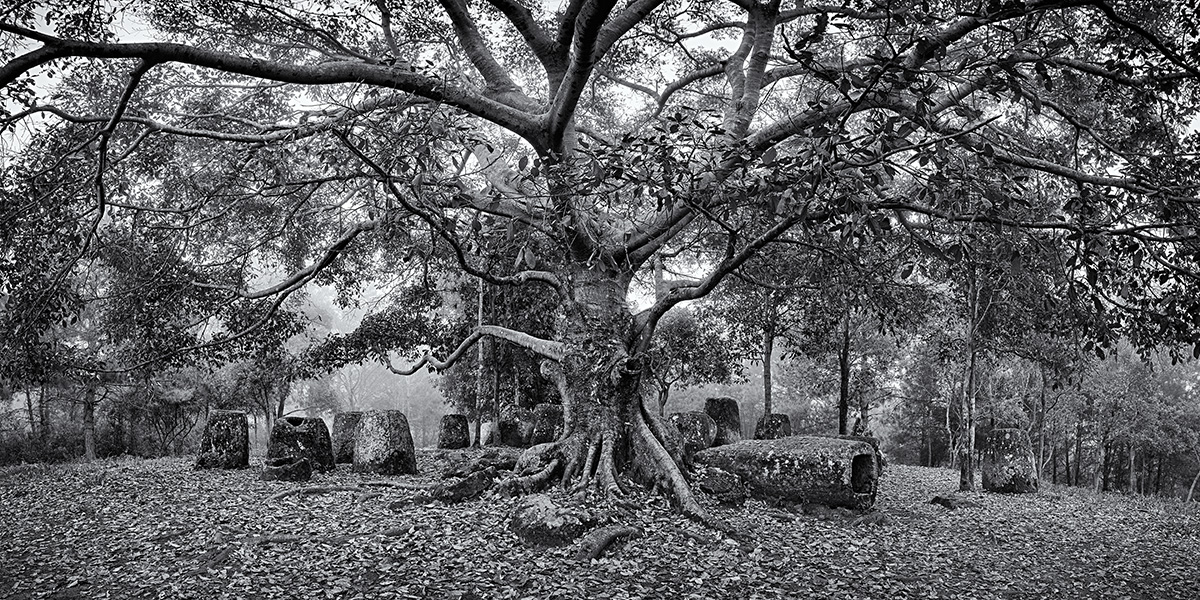
It maybe be hard to tell, but this isn’t a small print… it is 22″ tall x 44″ wide. With the frame, it’s roughly 31″ x 55″ and quite heavy. The framer did an amazing job—I had not considered a black mat with a white bevel, but I quite like it. The organic pattern on the frame is a natural extension of the tree itself. A good frame job really emphasizes the artwork and also makes it look better—all without drawing attention to itself. This is a really well thought out example of that.
This is one of the images from my Plain of Jars series. Click the image below for a large view:
I’m always interested when a photo of me doesn’t look like me.
Robert said this to me when we were doing a rough edit of the images we had just finished shooting. I had been wanting to photograph him for a couple of years, but the timing was never right. I had had an idea of the exact composition beforehand—I wanted him dressed in the same suit that you can see him performing in here, sitting in a low chair (my friend Walter had this sun-bleached chair outside for several years; when he sat in it one day, a leg broke, so he sawed the other three to match—I’m obsessed with the color), with his pant legs being pulled up above his boots by the low position, and crouching forward with his arms on his knees. The pose came from the Greek statue called The Boxer of Quirinal, but I always associated with the name Thom Jones gave it in his blunt-force-trauma collection of short stories The Pugilist At Rest.
I’m very proud to announce that a panoramic photo I shot in Laos earlier this year, Buddha Tree In The Mist, was one of the 150 panoramas selected out of 1677 submissions for publication in Kolor’s Panobook 2014.
Buddha Tree In The Mist
This panorama was shot as part of my upcoming series The Plain Of Jars. It was also the reward for $1000 donors on my Plain Of Jars Project crowdsource fundraiser on StartSomeGood for a small school in Phonsavan, Laos, called the Lone Buffalo Foundation.
My photographic interests are fairly broad, from modern digital all the way back to the antique or alternative processes. That’s why I was very happy to see this short video Escape To Nature about Alex Timmermans and his wet plate collodion photography. It was shot by Patrice Lesueur, and is beautiful in its own right. Take a look… (more…)
It had been a long time since I had seen my old friend Robert Sarazin Blake play, and I hadn’t yet seen him with his new band The Put It All Down In A Letters. The band is tight and Robert is better than ever. His music used to be described as folk punk, but I always thought of it more as angst folk. That’s a bit different now—the politics are still there, but the corners are smooth, the edges aren’t so biting. He’s always been one to work the crowd, but he’s smoother now—a reliable confidence on stage that is the hallmark of—really something more than—an entertainer.
I’ve been thinking a lot the last few days. Fred Branfman, a person who I consider a true American hero (and I do not use the term hero often—sadly it has become watered down from overuse—and misuse), passed away last week. And, in addition to the sadness I felt, I felt a pang of guilt. Fred and I had been corresponding ever since I got involved in Laos and discovered the horror—and the millions of still-deadly bombs littering the landscape—caused by America’s “Secret War” there. I think Fred was the first American civilian that discovered the brutal campaign we were waging—and I think he carried that unimaginable weight on his shoulders his whole life. This article When Chomsky Wept (and this obituary, will give you some insight into Fred).
Fred Branfman From The Front Page Of The POJP Website
Now, Fred was not a person to send you an email comprised of one sentence—he wanted to know everything about what you were doing, why you were doing it, and how it was going. I have an email in my inbox from Fred and it is labeled “draft” as I had not finished it, supposedly to do more important things. Here is what Fred asked:
Are you still in the PDJ? (Plaine de Jarres; from the French)
How much did you make from you fundraiser?
Then stated:
I am very interested, if you have time, to learn more about what life is like on the PdJ, the life of the people, the degree to which the government cares about the people, specifics on the LBF (Lone Buffalo Foundation), etc. And YOU—how are you doing?
The man never stopped caring about the people of the Plain of Jars, of the people of Laos.
Now the guilt: One day I was at Site 1 of the Plain Of Jars and I saw an amazing view with the sun breaking through the clouds over the jar site below. I took one look and knew that this was an image I was taking for Fred. I sent him the image and he loved it.
Later, I named the image Tribute To FB in his honor. It was the most requested image from the gallery of reward images for the project. I wanted to tell Fred that. I wanted to tell him that an image I loved, he loved, and that I shot specifically for him was now named after him and was the most popular of all my POJP photos.
And I didn’t. I didn’t because other things got in the way—things in hindsight that I can’t even remember; things that weren’t important at all. I can’t tell him, show him, because now it is too late. And I’m sad that I couldn’t pay back, in the tiniest way possible, the inspiration I got from Fred.