Below is a picture of half the Chronos Light time-lapse rig used to shoot the image sequence—there is another tripod below, securing the other end of the rail.
Related posts:
Leaving Laos! What was supposed to be a trip of a few…
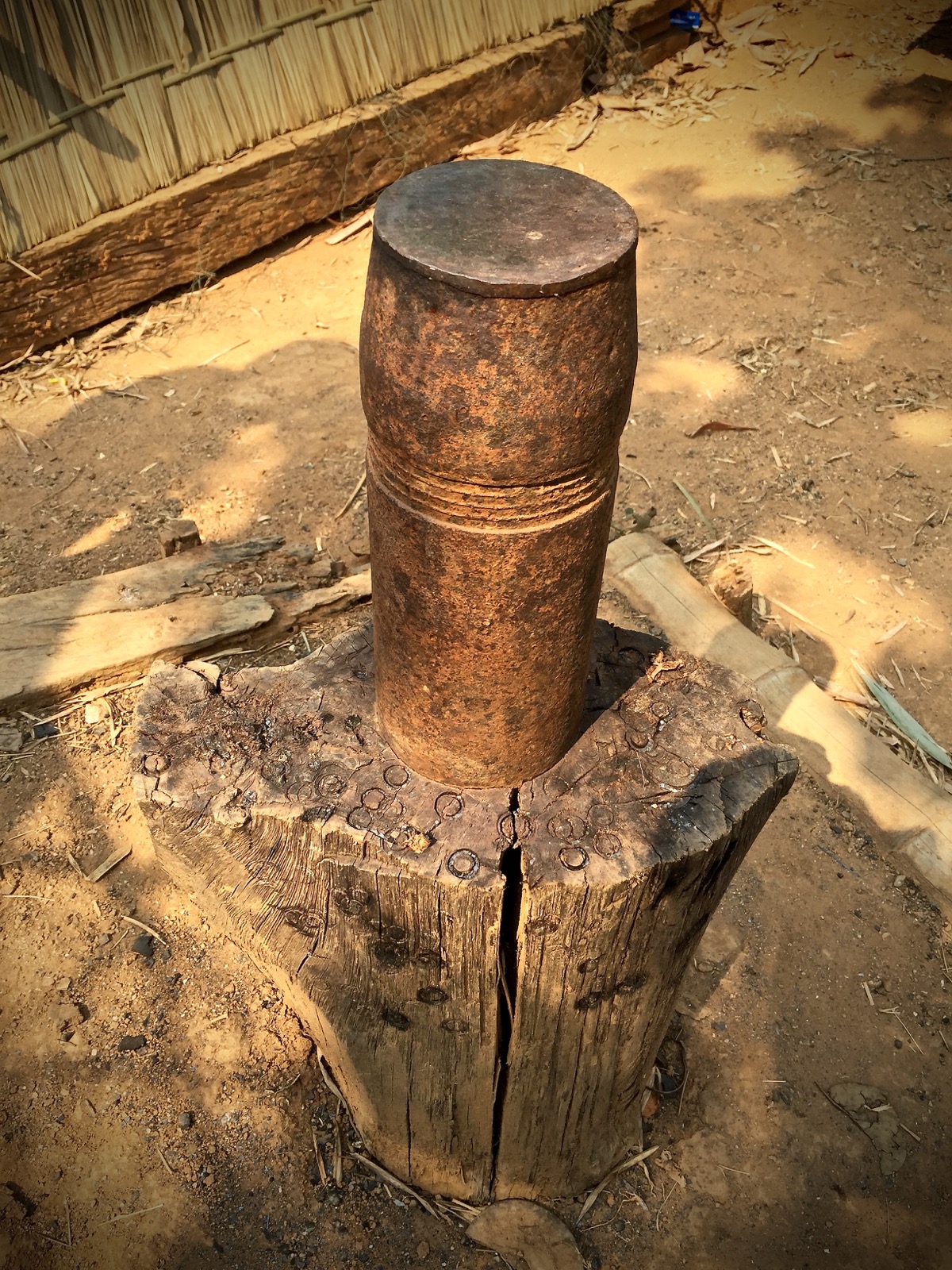
How about artillery shells in anvils instead? The only problem with the swords into plowshares analogy is that swords don’t kill or maim you when you hit them with a hammer.
This is the seventh US 105mm howitzer shell I’ve found in Laos used in this manner. They are used by the village blacksmiths as anvils to make farming implements and other tools. Probably the most utilitarian usage of Unexploded Ordnance (UXO) that I’ve found.
Special thanks to Philip for photographing me—it’s his father’s anvil…
Related posts:
Leaving Laos! What was supposed to be a trip of a few…
I recently taught a filmmaking class to a group of students at the Lone Buffalo Foundation in Phonsavan, Laos. Since Laos is the, per capita, most heavily bombed country on the globe, I thought that Tom Waits’ Hell Broke Luce might be a good, if difficult, choice to show the concept of symbolism.
Well, I was right on that last count. Not only was it difficult, it was downright incomprehensible to the students. It’s an oddly uncomfortable feeling to be standing up in front of a class after showing a video that you are excited about and feel is a perfect example for a certain aspect of your lesson plan, and have the entire class look at you as if you, and the video, are from another planet. I wasn’t sure why Hell Broke Luce had flopped as an example, but the class was nearing its end so we wrapped things up for the day.
However, a few weeks later, I realized I wanted to give it another go. Symbolism is, when used well, an incredibly effective means of telling a story without the direct use of language. When effectively combined with language (in this case lyrics), it can then be even more powerful. It was worth giving it another try.
So, I spent some time thinking about the reasons why the students hadn’t connected with the video. I came up with four:
With all the excitement of the our film being shown at the Vientianale Film Festival (a group of Lone Buffalo students made an Unexploded Ordnance (UXO) awareness film for youngsters) I had been remiss in posting some of the photos of the crew and production.
(For photos of the students at the film festival, see here.)
I’ll make up for that now:
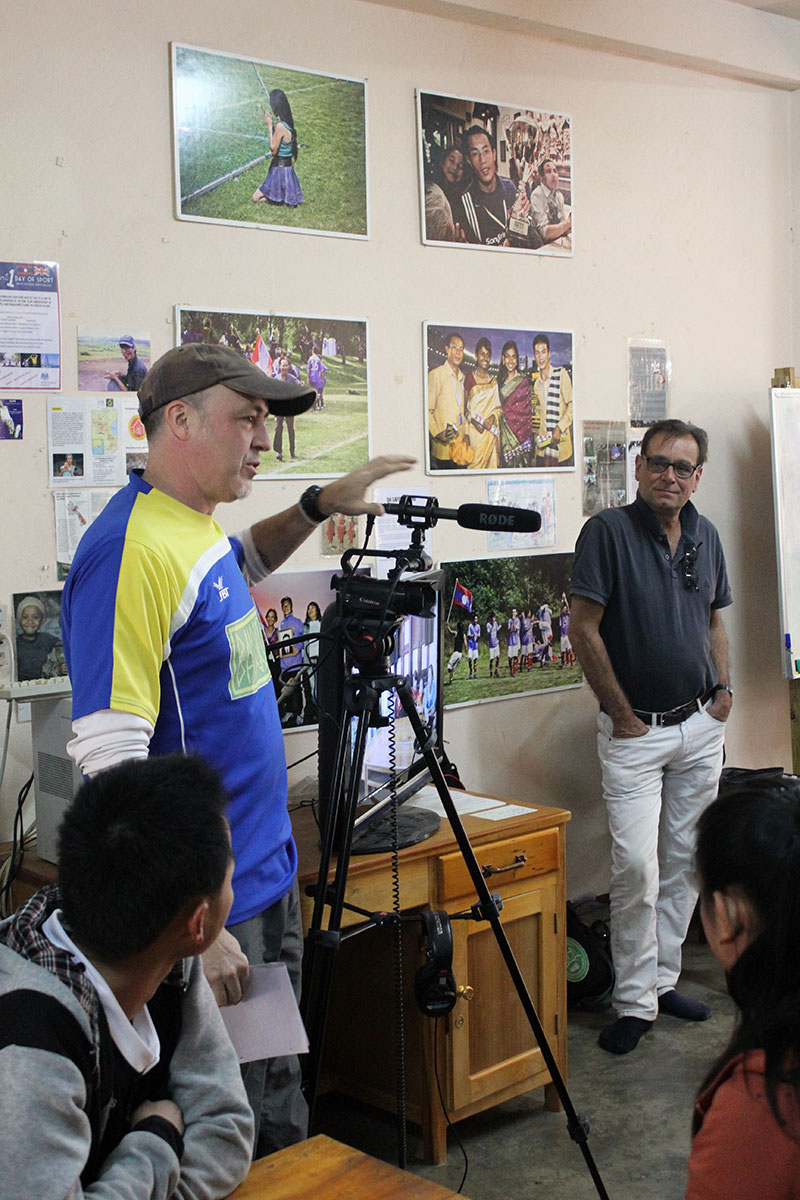
That’s me to the left and the wonderful James Thomas to the right. James is a journalist and volunteered to help produce the film; his wife Jackie was a volunteer English teacher at Lone Buffalo.
That’s Ms. Pa on the floor next to me. We were exploring the concept of using a low camera angle to make a subject seem larger or more powerful.
Or should I have titled this post Travel is Travail in Laos? I’m doing a video shoot for an NGO and one of the field staff and I were headed north from Vientiane to Phonsavan—the first leg of a six leg trip. And the worst leg: ten hours of getting battered around in what was in its previous life an airport shuttle, now converted into an off-road, long-haul, urm… marvel of transportation efficiency. That is until it isn’t. Until it is driven into a ditch and you start to roll over…
Only two of the students had ever been to the Capitol, so it was quite the experience for them. It was quite a trip—nine hours on a bumpy, serpentine road. There was extensive car sickness, even with a dosing of motion sickness medication before we left Phonsavan…
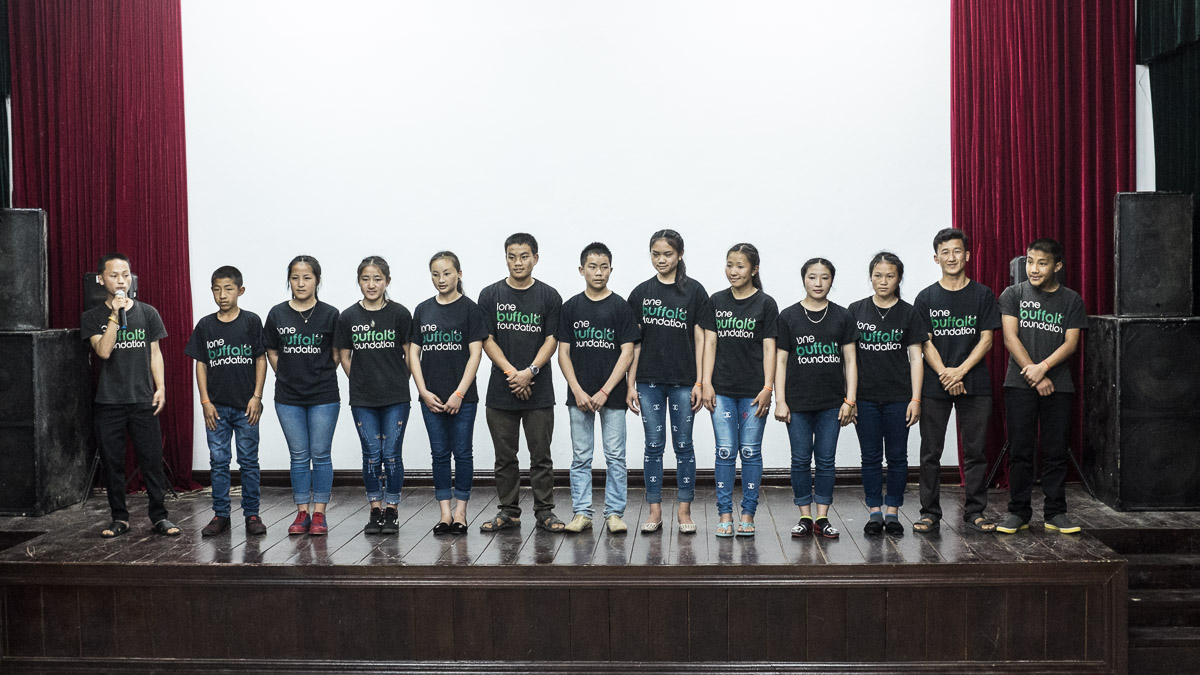
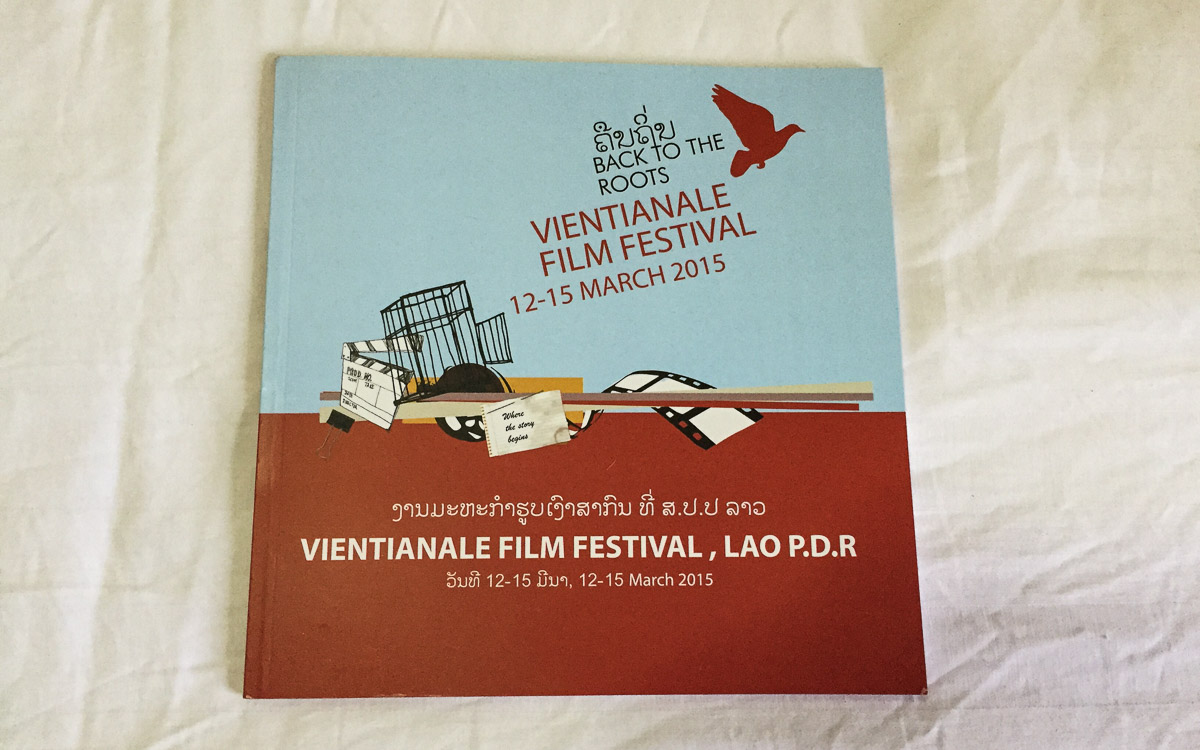
The Students (and Philip, Second From Right) Presenting Their FilmPosing In Front Of The Vientianale Sponsor Board. That’s Paula, Another Teacher, To The RightThe Vientianale Program
But even with all the excitement of the festival, I think the following photograph captures my favorite experience of the entire trip. Philip (one of the teachers at Lone Buffalo, my translator during the film classes, and one of my all-time favorite people in Laos) was sitting next to Kou Kham, who is all of twelve years old (and one of the actors in the film). Kou Kham had a rough time of the trip, and after a long bout of car sickness, pretty much just passed out. Of course, you end up bouncing all over, which just adds to your intestinal misery.
Philip laid him down and hung onto him so he could get some rest. Right as this happened, that orange-red Lao sun broke through the clouds and lit up the inside of the bus. The light was gone a few seconds later.
These are the kind of people I meet in Laos; These people are the reason why I keep coming back.
I woke up the other morning to find an email from a good friend of mine, Nathaniel. He sent me a nice little surprise: an article on America’s National Public Radio (NPR) about the man, Manophet, that was the impetus for the creation of the school in Laos, The Lone Buffalo Foundation, where I volunteer.
See the article The Lone Buffalo Cleared Unexploded Bombs And Boosted Needy Kidshere.
The sad thing is in the main photo of Manophet: he’s climbing out of a bomb crater—and I knew exactly where he was. I had visited the same area last year for the Plain of Jars Project. It is an area called Ban Kai (ban=village).
I shot two short videos there, Visiting The Plain Of Scars Part #1 & #2:
While I was looking at the photo of Manophet, the first verse of Tom Waits’ song Hell Broke Luce popped into my head:
I had a good home but I left I had a good home but I left, right, left That big fucking bomb made me deaf, deaf A Humvee mechanic put his Kevlar on wrong I guarantee you’ll meet up with a suicide bomb Hell broke luce Hell broke luce
I’ve always felt comfortable—if not occasionally a bit of a spectacle—in remote villages in Laos. When a Hmong-American English teacher asked me if I would like to visit her grandmother in her village about 15 kilometers outside of Phonsavan, I jumped at the chance.
And you are?
She was wonderful. Not only did she warm up to me quickly, she wasn’t shy about the camera in the least. I asked her granddaughter twice to make sure she didn’t mind, and it rapidly became apparent that she was at ease with the large (I’m a little over 6′ and about 205 pounds; I estimated her to be about 4′ 9″ and maybe 75 pounds dripping wet.), strange man sitting quite close to her and pointing a very large camera at her. My friend thought that I might have been the first caucasian person to have ever visited her village…
Comfortable with me…
Nobody knows for sure, but she is most likely in her early- to mid-eighties. She had a wonderful vibrancy about her—curious and laughing away at her granddaughters’ chatter. When I showed her one of the photos I had taken of her, she said with mild disdain You should photograph younger people.
Laughing at her granddaughters’ chatter.
There was a cooking fire in the house that had turned to embers and tiny bits of ashes were blowing around in the hot afternoon air. We wandered off for a bit to visit the other relatives’ houses and when we returned she was asleep and snoring softly. I didn’t want to wake her, but she had instructed her other grandchildren to wake her up when we returned.
Thinking about the past, thinking about the future.
As we left I said to her the only sentence in Hmong that I know: Shii gii doua (roughly: See you later). I think she found that very amusing—a falang that speaks Hmong! She gave me a huge smile and wished me good health as we left.
Hmong Grandmother.
Related posts:
Leaving Laos! What was supposed to be a trip of a few…
Hmong Wedding Last year I spent twelve weeks working on a photography…
Truck-ferry-shuttle bus-plane-plane-plane-truck-overnight bus-minivan. About 50 hours total of travel.
I’ve just arrived in Phonsavan, Laos, a small city on the Plain of Jars. I had gotten my bags out of the minivan and got set up in my guesthouse of choice, the Nam Chai. I decided to wander a bit, which, in the afternoons, usually takes me to the Hmong food market. I grabbed my camera and my audio recorder and set off.
I hadn’t even gone 45 paces (yes, I went back and counted them, I’m odd like that) and came across a pile of American cluster bomb casings, courtesy of my country during the Secret War from 1964-1973.
Me, My Shadow, And Some Cluster Bomb Casings
Even with three trips to Laos now under my belt, I’m still surprised at my reaction when I come across the staggering amount of war detritus—much of it Unexploded Ordnance (UXO)—that remains in this country. A country with roughly the same land area as the US State of Utah.*
As an old friend might say You can’t swing a dead cat without hitting UXO in Laos. Of course, you would be wise to, one, not swing things at UXO if you wish to live a long and fruitful life, and, two, leave dead cats alone.
*About 4,000,000,000 pounds dropped on 91,429 sq miles—about 43,750 pounds for each square mile. Of course it wasn’t distributed evenly, but your mental image should be clear.
Welcome To Laos: Me, Myself, And A Few Cluster Bomb Casings
I was photographing at a hospital in Laos with the team from Doctors Without Borders, and I turned around and noticed one of these sheets blowing in the wind. As usual, I had my camera preview set to black and white and the shape and motion really caught my eye. (Be careful with the volume level if you are using a laptop or tiny speakers—YouTube really beat up the audio!)
If you can’t see the video above, please click here.
I don’t know if anyone else finds it beautiful—or meditative—maybe I do as I simply have an emotional attachment to that experience in Laos. Sometimes I find it hard to separate the experience while photographing something and the actual thing being photographed. Maybe it’s the fact that I know this sheet was from the operating theater and people have lived and died on it. Maybe to most people it’s just a piece of fabric drying on a line someplace they’ll never see.
I could probably come up with a thoughtful metaphor for the sheet symbolizing how a person I knew moved gracefully on the earth and was as thin and weightless as that sheet when she left it. Maybe there is more there than meets the eye—but maybe not. Maybe one has to know the story behind the image to find meaning in it. Or better yet, can impart their story, their meaning to it.
Related posts:
Leaving Laos! What was supposed to be a trip of a few…