
Category: Alt Process Photography
-
Emil Schildt: Light Painting and the Bromoil Process
httpv://vimeo.com/131958809
If you can’t see the video above, click here.
Thanks again to my friend Derek who passed along the original post—he also called the video “Very ‘poser-y’ which it is… Well, Dr. Freud, what do you think about my photographs of naked women?? All joking aside, some very beautiful light painting and wonderful use of the bromoil process by Emil Schildt.
Orignial link:
http://www.iso1200.com/2015/06/all-or-nothing-every-single-time-light.html
Check out the Blurb book of his work, also.
-
Myriads of Gods on Platinum Palladium Prints
Here is a wonderful video of a Japanese photographer that makes images of the environment he is afraid may disappear—and makes platinum palladium prints, a process from the early 1800s. The artistry and the craft that this man employs is just astounding. The paper he uses has the potential to last 1000 years…
If you can’t see the video above, click here.
-
Collotype: A Story of Ink & Steel
This is a great little video on a beautiful antique photographic print process called the collotype. Originally created in 1856, sadly there are only two collotype printing companies in the world, both in Kyoto, Japan. Only one, Benrido can do color collotypes:
If you can’t see the video above, click here.
I find it very sad that in the not so distant future, the commercial usage of the process may disappear completely. I was alerted to this video by my good friend Derek who sent me the article A Look at Benrido, One of the Last Collotype Printers in the World at Petapixel, where you can find several other videos on the process.
-
Alex Timmermans’ Escape To Nature
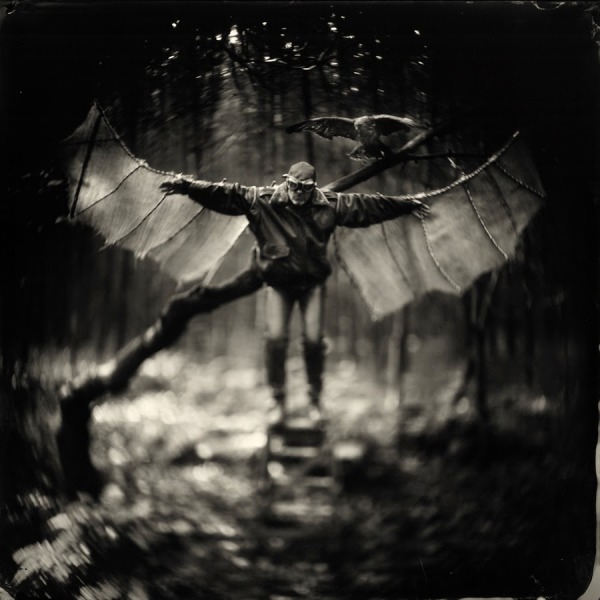
“Flight Instruction” Copyright Alex Timmermans My photographic interests are fairly broad, from modern digital all the way back to the antique or alternative processes. That’s why I was very happy to see this short video Escape To Nature about Alex Timmermans and his wet plate collodion photography. It was shot by Patrice Lesueur, and is beautiful in its own right. Take a look… (more…)
-
The Stunning Work Of Michael Massaia
I’ve discovered a photographer whose work I really love: Michael Massaia. He creates stunning black and white images of desolation and emptiness, but not in a way that leaves one depressed, but more in a way that leaves one fascinated. To top it off, Massaia uses large format film cameras and creates his look in the darkroom. He is an incredibly skilled printer.
Take a look at his portfolios here. Watch a video about him and his process here.

Afterlife -
Dennis Ziliotto And The Wet Plate Collodion Clown
Time for a little break from the Plain of Jars Project. I haven’t yet ventured into working with wet plate collodion, a photographic process from the 1800s, but in anticipation I’m a member of two great Facebook groups, one the Wet Plate Collodion Group, and the other, the wonderfully named Collodion Bastards: Wet Plate Work of Questionable Parentage. There is just absolutely stunning work in both, but I came across an image that I can’t stop looking at. Here it is:

The only word I can come up with is mesmerizing. It is almost as if the image is so disturbing that I can’t look at it for long, but I keep coming back to it. At one moment the clown is sad, the next threatening, and then the next just looking, with no intent whatsoever. I love that each time I look at it, I get a different impression.
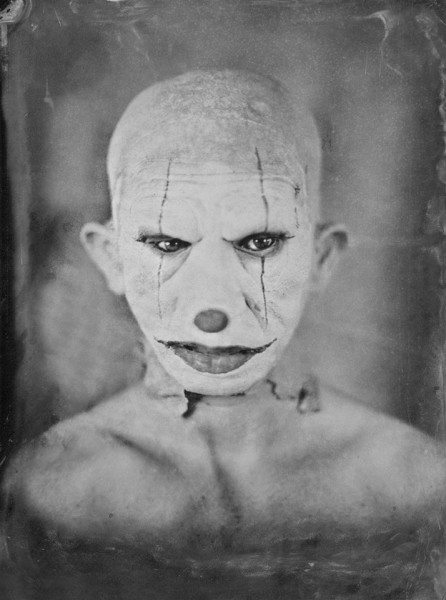
I truly thought it was a man made up with makeup, but as you can see below, I was wrong on both counts.
-
David Emitt Adams: Conversations with History
David Emitt Adams’ creative take on the history of what is no longer of use is just wonderful:

Conversations With History Take a look at what he does with aging evidence of human existence—turned into art—by a venerable photographic process from the 1800s.
Emitt-Adams states:
-
The Platinotypist “A little African story”
Continuing the theme of Tuesday’s post about alternative printing processes is another short video, The Platinotypist, about the platinum palladium printing process. What appeals to me very much about working with alternative materials is the hands-on nature of the process. Unless you are printing digital negatives, the process doesn’t require a computer and only a minimal amount electrical equipment. I wouldn’t call it a minimalist process as you need a darkroom facility of sorts and other specialized equipment. I think what is different is the element of craft. That isn’t to say digital photographers have no craft, quite the opposite. But this is a visceral, tactile craft; alt. processes require one to mix chemicals, work with cotton paper and gums and carbon and silver. And the output is unique. You can’t just print the file out again. Along with the craft comes a bit of chance, of risk. If things go badly (as they are wont to do) you have to start anew. But when you have that finished piece of art, it is one of a kind, there is no duplicate of it. That is more than a piece of art, it is a piece of a nearly forgotten history.
httpv://vimeo.com/82288614
Vimeo link here.
The Platinotypist “A little African story.”
-
New Camera, Old Process: Leica Monochrom And Platinum Palladium Prints By Manuel Gomes Teixeira
This is a wonderful video on mixing a late 1800s printing process with a Leica Monochrom digital camera. I’ve long been a fan of alternative printing processes and have taken classes in cyanotype and gum bichromate printing. I think my next venture into that alchemical realm will be wet-plate collodion, but that means another camera and a darkroom…
Vimeo link here.
If you are interested in photographic antiquity, here is a wonderful resource describing the various processes. Or dig deep into Bostick and Sullivan’s store for all the alt. process materials you may want.
New Camera, Old Process: Leica Monochrom And Platinum Palladium Prints By Manuel Gomes Teixeira.


