I recently taught a filmmaking class to a group of students at the Lone Buffalo Foundation in Phonsavan, Laos. Since Laos is the, per capita, most heavily bombed country on the globe, I thought that Tom Waits’ Hell Broke Luce might be a good, if difficult, choice to show the concept of symbolism.
If you can’t see the video above, click here.
Well, I was right on that last count. Not only was it difficult, it was downright incomprehensible to the students. It’s an oddly uncomfortable feeling to be standing up in front of a class after showing a video that you are excited about and feel is a perfect example for a certain aspect of your lesson plan, and have the entire class look at you as if you, and the video, are from another planet. I wasn’t sure why Hell Broke Luce had flopped as an example, but the class was nearing its end so we wrapped things up for the day.
However, a few weeks later, I realized I wanted to give it another go. Symbolism is, when used well, an incredibly effective means of telling a story without the direct use of language. When effectively combined with language (in this case lyrics), it can then be even more powerful. It was worth giving it another try.
So, I spent some time thinking about the reasons why the students hadn’t connected with the video. I came up with four:
- Symbols, by their very nature are intimately, culturally specific.
- If I understand correctly, the words home and house are similar if not the same in Laotian. In English, they can be used interchangeably, but home has a much more complex meaning than the simpler word house.
- I was explaining the elements of symbolism through a translator. A large percentage of the students in the class are ethnic Hmong. That meant that what I was saying was going through this mental language grinder: English to Lao, Lao to Hmong.
- Here was another wrench in the cogs that I hadn’t even considered: many of the advanced students literally couldn’t understand Waits’ English—his gravelly “cigarettes and whisky” singing style was just too foreign—too foreign even to the students with very good English skills.
At that point I had an idea. At the time the students were making a short film Haam Giap! (Don’t Touch!) which is an Unexploded Ordnance (UXO) awareness film for young children. The film was scheduled at the Vientianale Film Festival. The theme of the film festival was Back to Roots. There was my connection: I decided to tie together the theme Back to Roots with the main symbol in Hell Broke Luce: the home (not house) that Waits’ soldier is physically and metaphorically attached to, perpetually in his physical and subconscious shadow.
(Early on, I don’t think any of the students understood the Vientianale’s theme Back to Roots. However, the English teachers at Lone Buffalo had incorporated the concept into their lesson plans and had worked with the students on the concept; that became fundamental to the success I felt when the students and I had our second go at the nature of symbolism in a later class.)
Here is what we discussed:
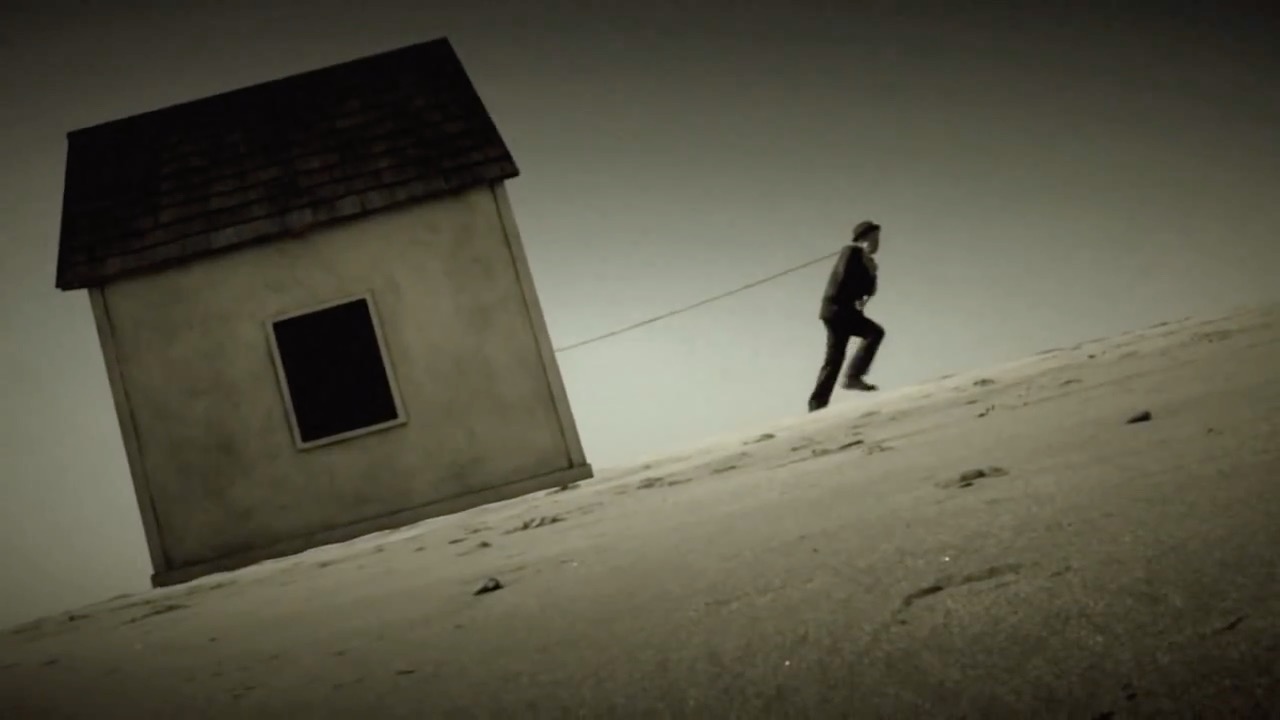
During the entirety of the video, Waits’ soldier is attached to his home, represented as a house. However, it isn’t just a building, it is his history, his people, his world view. His state of mind. His home—his roots.
I had a good home but I left
I had a good home but I left, right, left
That big fucking bomb made me deaf, deaf
A Humvee mechanic put his Kevlar on wrong
I guarantee you’ll meet up with a suicide bomb
Hell broke luce
Hell broke luce
We noticed that the pulling of the house appears to be a struggle. At 0:48 Waits’ soldier is pulling his home perilously up a cliff; At 1:50, up a steep incline. Is this struggle symbolic of trying to bring (or in case of war, force) your culture into a foreign land? Or of being in a war in a foreign land and your own culture is in some way a burden?

At 2:00 soldiers are parachuting in. Their parachutes, however, are houses. No matter who they are, what they are doing, they must always bring along that part of themselves, that part that is their home.

At 3:10 there is a stunning scene: Waits’ soldier is standing, holding the inevitable rope to his home. He’s looking back at the damage he (or more accurately, his home being used symbolically as his country or culture) has wrought. Laos isn’t Christian, so I did have to explain what the crosses and headstones meant. I simply equated them to stupas and the students got it.

At 3:35 we see Waits’ soldier, after returning home. He’s standing, rope to his home in his hand. There is a row of homes with enough space for his, the space seems to be beckoning him, if to say come back and join us.
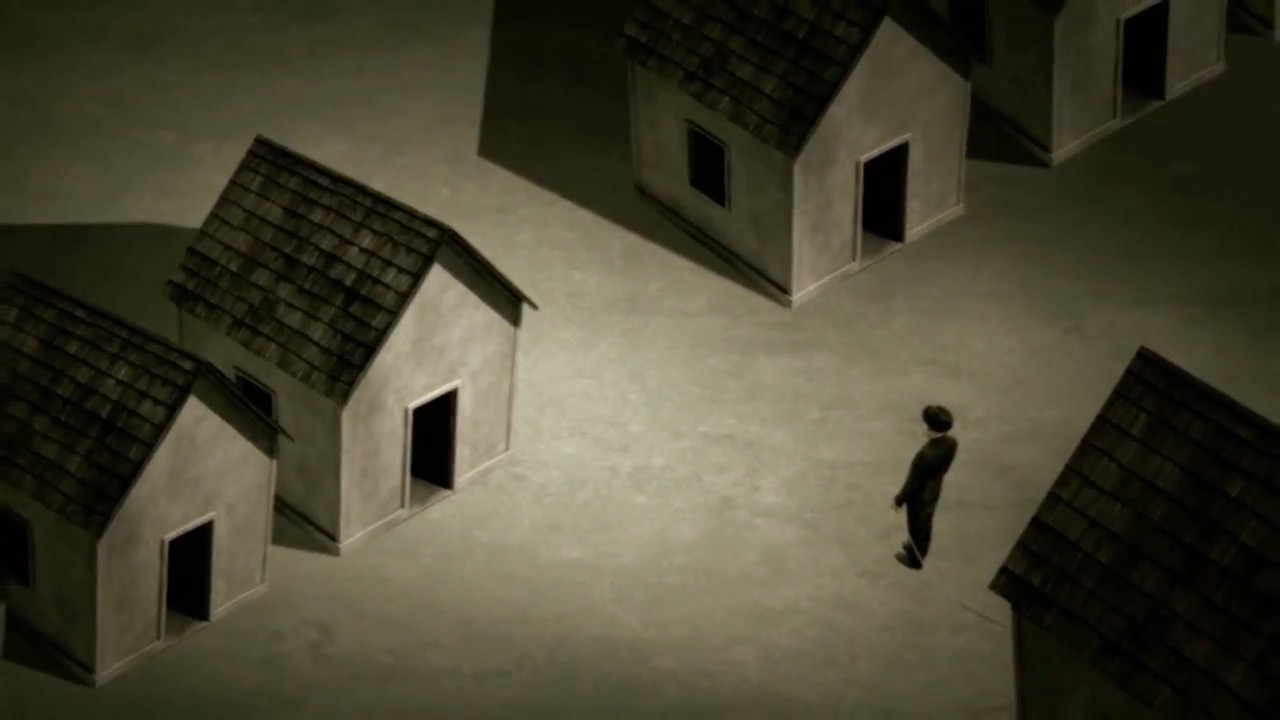
But then at 3:40 the houses slide together. There is no more space, no invitation, no place. Does this harken back to the soldier from Vietnam who comes back, not as my father did from WWII to cheers and accolades, but to aggression and anger? I really saw a spark in some of the students’ eyes at this point, they somehow felt, understood, what had happened. The soldier no longer had a place in his community. He has a house; he has no home.

The last scenes are the most emblematic for the entire video: Waits’ soldier is back in his house. He states:
Now I’m home and I’m blind
And I’m broke
What is next?
He is in a window, but you cannot see his arm or legs, he states that he’s blind (I’ve recently had the painful experience of meeting several young Lao Unexploded Ordnance survivors that have found themselves in a similar condition after they have encountered American Vietnam-era cluster bombs: two men each blinded in both eyes and each with both hands amputated, a third lost both legs). This, to a certain extent reminded me of a book I had read as a teenager: Johnny Got His Gun.
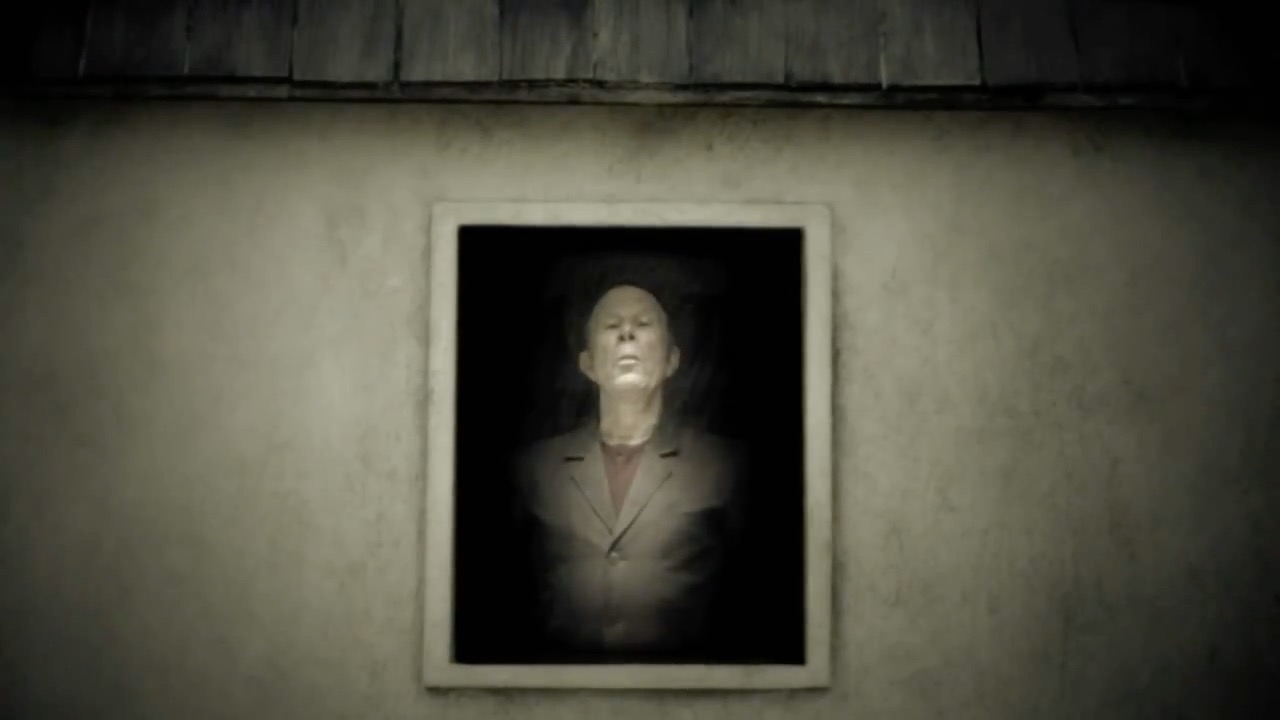
His house is being supported by another; he can no longer suppport it himself as a direct consequence of the war. The ground is made up of sand (a reference to the Middle East, no doubt). But more importantly, the sands are shifting—a symbol of the lack of stability now in the man’s life.

He asks What is next? His future, his life, irrevocably changed, damaged, destroyed. He and his home move away into the distance. Move away into the darkening corner of the scene.
The representational house in the video is just one symbolic element in a video rife with symbolism. The students and I discussed several more, which turned out to be more of me explaining to them what the symbols meant from a Western point of view. They had no notion that circling vultures were equated with death (I did do research. They are rare, but there are—Asian White-Backed—vultures in this part of the world). We also—carefully, on my part—discussed the generals (I also equated them to politicians) portrayed in the video and that they are never the ones dying or being physically or mentally maimed on the battlefield. The students also, which for some reason surprised me, understood what body bags were, shown at 1:22.
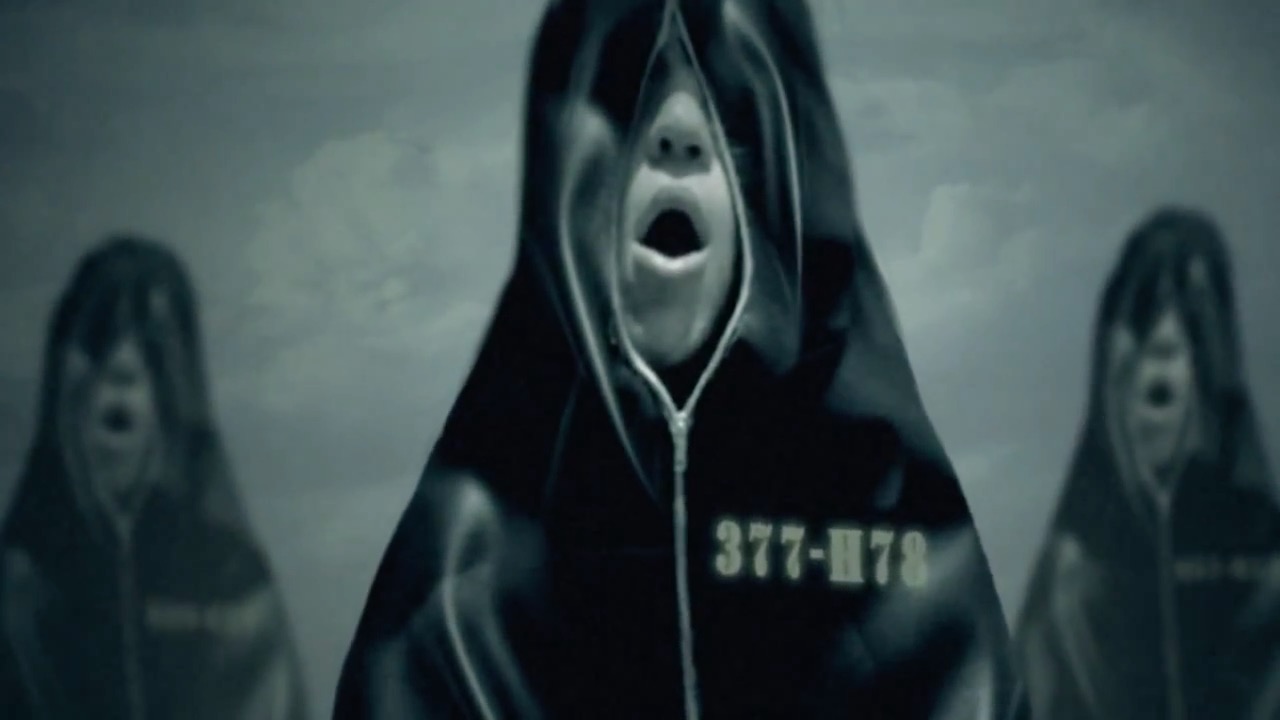
I also replayed the lyrics:
Nimrod Bodfish have you any wool?
Get me another body bag the body bag’s full
My face was scorched, scorched
I miss my home I miss my porch, porch
Left, right, left
Unlike the sound of a lead balloon hitting the floor with a resounding crash, the second class on symbolism went well. It is always tough working through a translator, but when the light goes on in someone’s eyes, regardless how well you can communicate through language, you can see when a seed has been planted. And this was a seed well worth planting.
Directed By Matt Mahurin.
“Hell Broke Luce” from the album Bad As Me, Anti Records 2011.
Writer(s): Kathleen Brennan, Thomas A. Waits.
All rights reserved by their respective artists.